
Over 30,000 SaaS companies are competing for the same buyers, and standing out has never been harder.
What keeps SaaS founders and marketing teams up at night isn’t traffic or awareness.
It’s questions like:
- Why are demos slowing down?
- Why are we spending more on marketing but booking fewer qualified calls?
- Why does lead generation feel unpredictable and hard to scale?
The challenge isn’t a lack of marketing channels. SaaS companies have more options than ever.
The real problem is knowing which strategies actually work to produce qualified leads and revenue.
This article breaks down the SaaS marketing strategies that actually work in 2026 and explains how to use them strategically to generate qualified sales conversations, not just impressions.
We’ll also share the approach we use at SalesBread to help B2B SaaS companies generate one qualified sales lead per day.
(If you want help turning these strategies into booked calls and demos, you can book a free 15-minute strategy call with SalesBread’s CEO, Jack Reamer, to see how ultra-refined list building and personalized outreach can work for your business.)
Why SaaS marketing can be challenging (and what that means for strategy)
Why SaaS marketing is uniquely challenging (and what that means for strategy)
SaaS marketing is harder than most people realize because you’re not selling a one-time product; you’re selling an ongoing decision.
Buyers don’t just choose your software once. They research it and evaluate it before the sale, during onboarding, and again every time they renew.
That means marketing doesn’t stop at the first demo or trial. You need to keep your current paying customers happy, so that they keep renewing.
Decision-makers compare tools, read content, follow founders, and talk internally long before they ever book a call.
By the time sales enter the picture, marketing has either done the work of building confidence in your product, or it hasn’t.
This is why visibility alone doesn’t move the needle. Familiarity and proof do.
At the same time, attribution in SaaS is messy.
A buyer might find you through content, see your brand on LinkedIn for months, click a retargeting ad, and only then respond to outbound.
Pricing adds another layer of complexity.
The price of your Saas product will determine the strategy you use. A $99/month product needs efficiency and volume. A $10,000/month product needs precision, trust, and timing.
Treating both with the same marketing playbook is one of the most common mistakes SaaS companies make. Strategy has to match price, sales motion, and risk tolerance.
This is what SaaS marketing needs in 2026: fewer tactics, clearer positioning, tighter ICPs, and strategies that prioritize fit over reach.
The companies that win are more relevant, more consistent, and far better aligned with how SaaS buyers actually make decisions.
How SaaS Pricing Impacts Your Marketing Strategy

Why is this important?
Because if you’re selling a $200/month Saas product and I’m selling a $2000/ month product, our marketing efforts are going to be quite different.
Knowing your price points will help you decide which form of marketing you can and can’t afford. Depending on your pricing, you could hire a small in-house sales team.
This could consist of 3 – 4 people.
Maybe an SDR, a prospector, and a closer.
But this might only work for companies that are selling high-ticket items.
If you’re selling lower-priced items or are a new start-up with a limited budget, you might consider hiring a freelance content marketer or a single SDR.

Realistically, your strategy really depends on what you can afford.
Finding the Right Target Audience for Your SaaS
When it comes to selling your Saas product, ask yourself, “WHO am I selling to?
You have 2 options:
-
You’re either selling to the end customer
Or
-
You’re selling through partnership campaigns – This means finding people who are already connected to the end customer. You will then need to create a strategy where you can reach out to potential partners who could be a referral source for your business.
Why does this matter?
Because if you’re selling lower-priced products, the CEO might have given buying power to a manager, for example. You could then contact the manager instead and try to win the sale.
But if you’re selling a product that’s $ 10,000 a month, contacting the CEO or the main decision-maker would be the best option.
The reason?
A lower-level employee might not be able to make such a huge buying decision for their company.
Whoever you’re selling to will influence the strategy that you choose to use.
How to Build a Targeted SaaS Prospect List Using Buying Data
If you do decide to use an outbound approach to your marketing, it’s important to build an ultra-refined prospecting list that is based on data.
So how would you do this?
Look at WHO has purchased your SaaS product within the past 6 months.
And then ask yourself, what do all these buyers have in common?
Once you figure out commonalities, it’s easier to build a look-alike list of potential customers.
Ask youself:
-
Are they located in the same area?
-
Are they in the same industry?
-
Do they have a specific number of subscribers or website visitors?
-
Have they recently been funded?
-
Do they use social media marketing?
-
Are they using a specific CRM tool? Like HubSpot or Salesforce?
-
Maybe you have noticed that they all have a high churn rate, and your Saas product can help solve that issue.
Here’s an example of how we would build a list of SaaS prospects…
In this episode, we cover things such as:
-
How to build a company list
-
The deeper side of how to list build
-
An example of using a website’s live chat feature for list building
-
Ideas on where to take your list-building
-
How a refined list can make your copy a breeze
-
Looking into foreign companies
-
Helpful tools you need for your list
-
Salesbread’s key insight on building your list
Once you have an ultra-refined list of prospects based on data, it’s easier to target the right businesses, which will give you better conversion rates.
Now that you have figured out your price points and your ideal customer profile, you can decide which form of marketing will be best for your business.
How We Used Targeted List Building to Book SaaS Leads
SalesBread was excellent at following through on their proposal, guided us on when to branch out to other industries, and helped us reach a far wider target audience than we could have on our own. Thank you.
SalesBread helped TheoremReach generate 183 Leads in 130 Business Days by using this same ultra-refined list-building approach. (Read the full SaaS case study here.)
The challenge
TheoremReach wanted to connect with top app developers on the Google Play Store to sell their SDK for app monetization.
While digital marketing was part of their long-term strategy, they needed sales-qualified leads fast without spending months building awareness or hiring an internal sales team.
Our B2B SaaS strategy
We focused on ultra-refined list building, manual personalization, and consistent follow-ups, rather than high-volume or outreach.
How we did it
-
Accessed data from 2.7 million Google Play apps
-
Refined the list by app category, download thresholds, and keyword signals
-
Narrowed the list to ~6,000 high-fit apps, then further refined it to 2,390 active, relevant developers
-
We then found the right founders and decision-makers on LinkedIn to reach out to. We made sure to first message people in 2nd-degree networks and those who were active on LinkedIn.
-
We then researched each prospect individually to send personalized outreach messages using the CCQ method (Compliments, Commonalities, Questions)
-
Followed up using a balanced Fibonacci-based cadence
-
Used clear, direct CTAs to move conversations toward booked meetings
The results
Most of our clients see their first qualified lead within 48 hours of launch, and this campaign was no different.
By focusing on list quality over volume, TheoremReach received sales-ready meetings, allowing their team to focus purely on closing, not prospecting.
We generated 183 Leads in 130 business days for them.
Why it worked
Instead of reaching out to thousands of random prospects, we prioritized fit, intent, and personalization. This approach turned targeted lists into real sales conversations, proving that in SaaS, who you reach matters far more than how many you reach.
If you would like the same results, reach out to us for a free 15-minute strategy session.
Top SaaS Marketing Strategies That Actually Work
Linkedin outreach

(With LinkedIn outreach, you could either do this on your own or hire an agency like Salesbread .)
LinkedIn outreach isn’t too complicated, but you need to have a super refined list of prospects (like we mentioned earlier) AND your messages have to be ultra personalized.
If you do these 2 things, then the chances of your campaign failing will be minimal.
On average, we are seeing positive reply rates on LinkedIn of 39%, which gives us 1 positive sales lead per day.
So here’s how to do it.
Step 1: Find the right people to reach out to, filter by your 2nd degree network AND recently posted
Once you have an ultra-refined list of prospects, you will then need to find the right people to reach out to.
If you notice that most of your buyers are founders, find the founders of the companies on your list on LinkedIn. Plug that list into LinkedIn Sales Navigator and filter by your second-degree network.
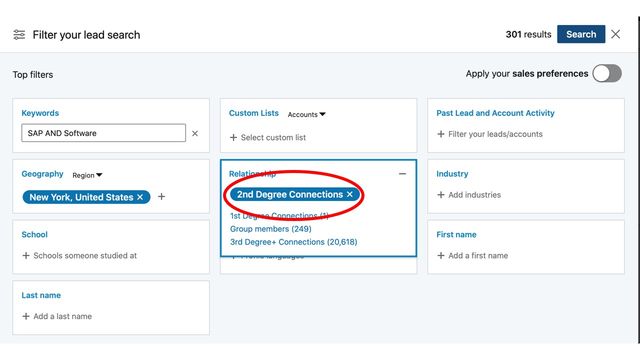
Why should you filter by your second-degree network?
The reason for this is that statistically speaking, prospects who are in your second-degree network will be more likely to connect with you than those who aren’t.
They have already accepted someone like you into their network, so the chances of them accepting you, too, will be high.
We also like to take that list and filter it by “Posted on LinkedIn recently.”
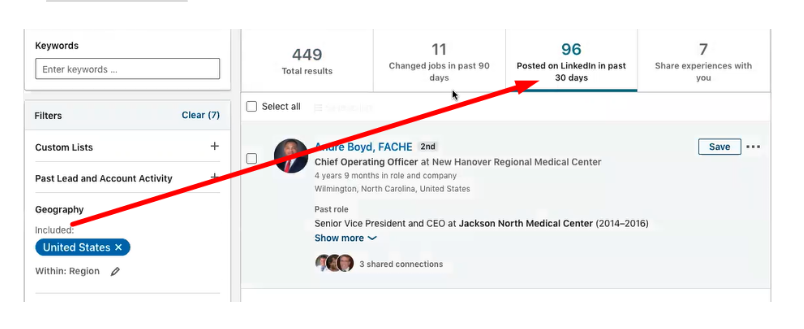
This helps us only reach out to prospects who are active on the platform. There’s no point in sending a prospect a message on LinkedIn if they are never online.
If this is the case, you could always add that individual to an email or SMS campaign.
Step 2: Research each prospect in order to write personalized messages
Founders get spammed daily on LinkedIn with hundreds of generic sales messages and connection requests. If you want your messages ot stand out, you have to personalize your outreach messages.
This means more than just using first name and company name.
Find something specific to mention in your outreach.
For example, was the prospect recently interviewed? Did they just receive a round of funding? If yes, mention that in your messaging.
This shows that you did your homework and will help you stand out.
(This article: 60 LinkedIn Connection Request Message Templates shares some personalized invites you can use if you would like to try this approach. )
Remember, when it comes to copywriting for outreach, use the 90/10 principle. This means speaking about the prospect 90% of the time and only 10% about yourself or your business for context.
Also, use the CCQ method. This means mentioning a commonality, sharing a compliment, or asking a question.
We also like to mention pain points that the prospect might be experiencing and subtly mention how the product could fix their problem.
This approach encourages prospects to engage with you.
Read this for more info on LinkedIn copywriting.
Here are some replies we received with our SaaS campaign for TheoremReach:
| Prospect Response |
|---|
| Hi ###, can you please send me some case studies. |
| Sorry for the late response. Let’s jump on a call this week to discuss more. Here’s my calendar – feel free to book a slot. |
| Hello ###, please email the proposal to salessupport@m######. |
| I’m happy to chat. |
| Tell me more. Sounds interesting. |
| It’s my pleasure to connect with you. Can you share some details in brief so I can discuss it with my Department Head and my team? |
| I appreciate your proactive approach 🙂 Ok, let’s talk! Next week Thursday/Friday? What is your time zone? |
| Could you please tell me more about your monetization solution, your benefits, and what makes you stand out among others? |
| I will speak with my monetization team about this. If it’s something that makes sense for us, I’ll let you know. |
| We are always looking for ways to increase ARPDAU and LTV. Mind sending me something I can share internally? |
Step 3: Follow up and ask for a booked meeting
Next, follow up until the prospect replies. We encourage you to use the Fibbonnaci sequence when following up, it just has a more natural rhythm to it.
If they don’t respond through LinkedIn, try cold email or SMS.
We have found that this works well.
Some marketing teams or sales reps feel nervous to ask for a booked call in their messages, but we have found that being direct and just asking for a sales call works really well.
Being transparent is also important.
If you hop on a call and start selling your service, it’s going to be super awkward if the prospect isn’t aware that you actually want to sell them something.
But here are some CTA ’s that we use when asking for a meeting.
-
What does your calendar look like over the next week?
-
Let’s hop on a quick 10-minute call to discuss?
-
Worth a short conversation?
-
Send me your calendar link, and I will book a spot
So, if you haven’t tried LinkedIn outreach for your SaaS company, give it a try. Most of our leads come in within the first 48 hours after launching our marketing campaigns.
LinkedIn Content Marketing

Most SaaS companies are “on LinkedIn.”
But very few are actually using it as a marketing channel that supports sales.
That’s the difference.
LinkedIn content marketing works for B2B SaaS companies because it puts your thinking, your positioning, and your proof directly in front of the people who make buying decisions, before you ever ask for a call.
If you have a LinkedIn content marketing strategy in place, and your ideal buyers see your thoughts over and over again, they are going to eventually see you as an expert in your field.
So when you eventually do reach out to them (if they haven’t reached out to you first), it will be easier to land that sales call.
In the SaaS world, buyers don’t wake up ready to book a demo.
They research quietly. They follow founders. They read posts. They watch who shows up consistently and who disappears.
LinkedIn is where that trust gets built in the public eye.
Why LinkedIn Is One of the Most Effective SaaS Marketing Strategies
Unlike most social media platforms, LinkedIn is designed around business.
Your core audience is already there: founders, product leaders, revenue teams, and decision-makers at B2B SaaS companies.
But here’s the part most SaaS businesses miss:
LinkedIn content isn’t about “going viral.” It’s about warming up the room.
When your content consistently speaks to real problems, prospects start to recognize your name long before a sales call or booked demo ever enters the picture.
How LinkedIn Content Supports the SaaS Marketing Funnel
We see this over and over again with SaaS businesses.
A prospect:
-
Sees a post about a problem they’re actively dealing with
-
Reads a case study or breakdown you shared
-
Mentally files your company under “worth paying attention to”
So when outreach or a referral happens later, the conversation doesn’t start cold.
That’s why LinkedIn content works best alongside outbound.
Content Marketing & SEO

When it comes to content marketing for Saas companies, I suggest reading the articles from Grow and Convert.
This is an excellent content marketing agency that focuses mainly on helping SaaS companies gain conversions from their websites and not just traffic.
But some of the things that they mention in their articles are that many Saas companies that try content marketing focus mainly on top-of-the-funnel topics.
This is because most marketing logic tells you to guide customers through each stage of the funnel.

But they argue that in almost every Saas company, there is already a “ significant portion of potential customers who are in the consideration and conversion stages.”
Grow and Convert suggests focusing on converting those who are ready to buy first.
Therefore, if you want more high-quality Saas customers who convert, focus your content marketing strategy on the bottom and middle of the funnel topics first.
For example, Best X software for employee time tracking.
After you’ve exhausted all these keywords and topics, work your way up the sales funnel to broader topics.
For example, in your SEO strategy, instead of using broad keywords, focus on keywords that qualified leads would most probably do a Google search for.
Like:
-
“Best X software”
-
“[Use case] software”
-
“[Industry] software”
-
“[Competitor] alternatives”
Watch the video below because it goes into more detail:
Content marketing and SEO also help your ideal clients find you through search.
You can imagine someone searching for the best staff scheduling app.

If your company is ranking in the top 3, the chances of them reaching out to you will be way higher than if they never find you through a Google search.
Visual assets created with an infographic maker can also improve engagement, increase backlinks, and make SaaS content more shareable across multiple channels
So you want to be in the top 10 search results for very specific buying intent keywords.
AI SEO

If your SEO is good, you will most likely show up in AI searches too.
Many sites are losing clicks because of AI, but if your normal SEO is stellar, you will show up in AI searches too.
The more specific you are on your website about who you are, what you do, and how you help your customers, the higher your chances will be that you show up in AI searches.
This article: How to Optimize Your Website and Content to Rank in AI Search Results, from XPONENT is quite helpful on how to do this.
But if you find that you’re struggling you could always hire an agency like Grow & Convert or get you started.
Other forms of content marketing include things such as:
PPC
SaaS PPC works when you use it to find existing demand, not create awareness.
Most SaaS companies waste budget by bidding on broad, educational keywords.
Rather, in the same way as SEO, focus only on buyer-intent keywords, like:
-
“software for [industry],”
-
“alternative to [competitor],”
-
Or keywords that include “pricing,” “demo,” or “trial.”
Lower volume, higher intent always wins because it gets you prospects who are actively looking for your solution.
It would also be a good idea to split your campaigns: bottom-of-funnel ads for people already shopping, and mid-funnel ads for people comparing options.
Then retarget the second group until they’re ready.
This alone improves lead quality fast.
Try to ensure that each ad lands on a single-purpose page that speaks to one ICP, one problem, and one CTA.
Some tips when it comes to pay-per-click for those in the SaaS industry are to do the following:
-
Ensure your PPC strategy is objective-led
-
Tailor your ads to your target market
-
Use retargeting campaigns
-
Optimize your PPC landing pages
-
Don’t rely only on Google Ads, but have a multi-channel approach
Search engine optimization of your articles and landing pages.
Use these tips when it comes to SEO for your product and landing pages
-
1-2 CTAs
-
Platform demo video
-
High-quality platform screenshots
-
Solution benefits
-
“What Is [Solution]” section (for the featured snippet)
-
Case studies internal links
-
Brand image trust signals
-
Competitor comparison table
-
FAQ section
-
An excellent website with a great user experience
Social media marketing on Facebook and Instagram

SaaS companies can also use Instagram and Meta as channels to warm up their audience, not direct sales channels. People aren’t opening Meta apps looking to book demos, they’re scrolling.
The goal of content is to build familiarity, trust, and problem awareness before someone ever clicks an ad or searches on Google.
Content should speak to one clear ICP and one clear pain at a time.
Try not write generic SaaS posts becasue these don’t convert.
Posts that call out a specific role, problem, or outcome stop the scroll and attract the right people.
You want to have a mix of content, such as short problem-to-outcome posts, lightweight education, opinionated takes, and most importantly, proof.
Case studies, results, before-and-after stories, and “here’s how X achieved Y” posts.. You’re not selling; you’re showing evidence.
You can use content to send people to guides, checklists, templates, or case studies instead of pushing demos immediately.
Once someone has engaged with your content or visited your site, you can then retarget them or reach out to them.
Paid advertising on social media

Paid advertising can be costly, especially if you’re trying out LinkedIn ads.
It’s not our favorite form of marketing because we have had many clients tell us that they spent over $10,000 on paid ads, and never even received 1 lead.
We aren’t saying don’t try it out… But if you do, only do it for 2 -3 months to see if you’re getting a return on investment.
Email Marketing
Saas email marketing is slightly more complex than it is for other industries. The reason?
Every SaaS company has to send 3 kinds of emails based on data.
A marketing email
This is an email sent to leads. This would include lead magnets, lead nurture campaigns, helpful information, sales campaigns, and newsletters.
Lifecycle email
This kind of email is sent to users who have already signed up for your software as a service.
These kinds of emails would include onboarding, loyalty programs, and encouragement to upgrade to more expensive packages if needed.
Transactional emails
This will include service emails like password recovery, product notifications, and invoices.
Some email marketing tips for SaaS companies
Email works in SaaS when it’s used to move people forward.
Every email should push the reader one step closer to activation, a demo, or a buying decision.
Start by segmenting properly.
A trial user, a demo no-show, and a content downloader should never get the same emails.
Even light segmentation can improve results.
Keep emails short and outcome-driven.
You can lead with the problem you solve, show one clear benefit, and end with a single CTA.
If someone can’t understand the point of the email in 10 seconds, it won’t get read.
And remember, proof beats features every time. Instead of listing what your product does, show what it achieves.
HOW it solves pain points.
Short case studies, results, quick examples, or “here’s how teams like yours use this” emails consistently outperform feature announcements.
For colder leads, use educational or comparison emails first, then introduce demos once intent is clear. Demo asks work best after you’ve already handled objections and shown value.
It’s also important to measure what matters. Open rates don’t close deals. Track activation rates, demo bookings, and trial-to-paid conversion.
If email isn’t moving people to the next step, your messaging might need some work.
We also like using personalized Loom videos for clients who show an interest. We basically just introduce ourselves and then share an interesting insight.
Whether it’s how we helped a company similar to theirs, or how we would help them find leads for their ideal target audience.
Webinars

Webinars are also great for your SaaS marketing plan. Here are some reasons why you might want to incorporate this tactic into your marketing strategy.
Educational Value:
Webinars are a great way to educate your target audience about your SaaS product. You can show your audience its features, show them how to use it, and chat about pain points that your tool solves.
This helps potential customers understand the value proposition more deeply.
Engagement and Interaction:
Webinars allow for real-time interaction with your audience. Attendees can ask you questions and even provide feedback.
This will build trust between your company and your audience.
Demonstrations and Use Cases:
For SaaS products, showing is often more important than telling. During your webinars, you can use live demonstrations, walk through use cases, and share success stories.
When you do this, it helps prospects see how your solution can solve their specific problems.
Lead Generation :
You can also use webinars to generate leads. For example, to attend the webinar, people often need to register.
This can give you a ton of helpful information, like their contact details, how big their companies are, and why they are interested in joining.
These leads are typically more engaged and interested in your product since they’ve invested time in attending the session.
Authority Building:
Hosting webinars can also show that your company is an authority in the industry.
By sharing valuable insights and your own strong opinions and thoughts, you establish credibility, making it more likely that attendees will view your SaaS solution as a trusted product.
Networking Opportunities:
Virtual events can also create networking opportunities. Attendees might connect with each other, sharing experiences, and this can create a sense of community around your product.
It’s also important to promote your webinars through different channels, like on your social media platforms and email marketing, to get more attendees. You could also record your webinars for those who couldn’t attend live.
This, in turn, can help you create content for your website.
Podcasts

Podcasts are a great lead magnet. Even at SalesBread, we often get leads from our podcast.
People don’t listen to podcasts to be pitched. They listen while driving, walking, or doing life, which means trust builds naturally over time.
The biggest mistake SaaS companies make is talking about their product too much.
The podcast shouldn’t be about you.
It should be about the problems your audience is already dealing with. When you consistently talk about those problems, with founders or even customers, listeners start to think, “These people get it.”
That’s what creates demand for your product.
When listeners hear real examples of how teams solved a problem, what failed, and what finally worked, they start connecting the dots themselves. By the time they check out your site, they’re already half-sold.
Instead of pushing demos, use soft offers that match the episode.
Share a guide, a checklist, or a short case study related to what was discussed. That feels helpful, not salesy, and it gives you a way to capture leads and follow up later through email or retargeting.
(If you’re interested in listening to our podcast, go here.)
Word of Mouth
Word of mouth is still one of the best ways to generate leads. If you provide amazing service, your customers are going to tell others about it.
If your clients have any issues, be sure to fix it asap. Great service will help you stand out from many other SaaS companies out there, which often have bad customer service ratings.
You could even encourage customers to share positive reviews and testimonials on your website and third-party review platforms, like G2 or Trustpilot.
This, in turn, builds social proof for your brand too, and getting mentioned on third-party review sites will also help you get mentioned in AI.
Another option is to implement a referral program that rewards existing customers for referring new users, creating a win-win scenario for both parties.
Give away freebies
In SaaS, “free” isn’t about generosity; it’s about reducing risk for your buyers.
Most buyers hesitate because they’re unsure whether a tool will actually solve their problem. Giving something away for free lowers that barrier and lets prospects experience value before they commit.
A free trial for a week or two, templates, calculators, checklists, audits, or mini-tools attract the right people because only those who are really interested will engage.
Free value also builds trust faster than any sales message.
When a prospect gets something helpful without being pressured to book a call, it changes the dynamic.
Instead of “What are you trying to sell me?”, the question becomes “How else can this help us?” That’s a much better starting point for a sales conversation.
Buyers want to test, compare, and validate quietly. A free resource or tool gives them a reason to engage, while giving you permission to follow up with relevant, contextual messaging later through email or retargeting.
Free should never be generic.
It should be designed to naturally lead into your paid solution. The best free offers solve part of the problem and make it obvious that the full solution requires the product.
In 2026, the SaaS companies that win aren’t the ones giving the most away. They’re the ones giving away the right thing to the right audience at the right moment in the buying journey.
Frequently asked questions about SaaS marketing strategies
What is a SaaS marketing strategy?
A SaaS marketing strategy is basically a plan for consistently generating qualified leads, demos, and revenue. It focuses on turning interest into ongoing customer relationships and sales.
What SaaS marketing strategies work best?
Some of the best SaaS marketing strategies are outbound lead generation, SEO for buyer-intent keywords, LinkedIn content marketing, email nurturing, and proof-driven campaigns like case studies.
It’s best to use a mix of methods for the best results, though.
Is inbound or outbound better for SaaS?
Neither is better on its own. Outbound brings in leads quickly, while inbound strategies like SEO and content compound over time. SaaS companies grow fastest when they use both together.
How long does SaaS marketing take to work?
Outbound and PPC can generate leads within weeks. SEO and content marketing typically take 3–6 months.
If a channel hasn’t influenced growth within 60–90 days, the issue is usually targeting or messaging.
Why do most SaaS marketing strategies fail?
Most SaaS marketing fails because teams focus on traffic and awareness instead of qualified leads and sales conversations. Without a clear ICP, proof, and follow-up system, marketing rarely converts into revenue.
How should SaaS companies measure marketing success?
SaaS companies should measure marketing success by pipeline generated, demo bookings, trial-to-paid conversion, churn reduction, and revenue, not clicks, impressions, or follower counts.
Is LinkedIn important for SaaS marketing?
Yes. LinkedIn is one of the most effective platforms for B2B SaaS marketing because it reaches decision-makers directly and helps warm prospects before outbound or demo requests.
What is the biggest SaaS marketing mistake?
The biggest mistake is trying to do too many channels at once. SaaS marketing works best when companies focus on 1–2 core strategies, make them predictable, and then layer in others.
Interested in getting more qualified leads for your SaaS company?
SaaS marketing in 2026 isn’t about chasing every channel; it’s about building a system that consistently turns the right companies into sales conversations.
So choose 1 or 2 of the best channels for your business, and once it gains traction, keep growing.
At SalesBread, we help B2B SaaS companies generate one qualified sales lead per day using ultra-refined list building and personalized outreach.
If you want a consistent flow of qualified leads, book a free 15-minute strategy call, and we’ll show you exactly how we’d approach it.
