
Fact: According to data from 1 million cold emails, 57.2% of replies come after your first follow-up email.
So, if you’re not sending lead follow-ups, you’ll miss out on business opportunities.
That’s why I say the follow-up email is a salesperson’s best friend.
But be cautious, follow-ups can sound repetitive, or worse, fail to add anything new to the conversation…
To make sure that your follow-ups offer the maximum chance of positive replies possible, we have compiled a list of 40 follow-up email templates to inspire you for your next campaign.
(Great follow-up emails only work when they’re paired with the right targeting and timing. If you want help turning follow-ups into booked meetings, book a free 15-minute strategy session with Jack Reamer, founder of SalesBread.)
Quick Summary (Cheat Sheet)
- Send your first follow-up 2–3 days after the initial email
- Keep follow-ups under 80 words
- Add new value in every follow-up (case study, stat, video, insight)
- Vary your CTA (question → Loom → call → close-out)
- Stop after 5–7 total attempts if there’s no response (Try again in a few months)
Follow-up email templates & examples for higher response rates
Quick Summary (Cheat Sheet)
-
Send your first follow-up 2–3 days after the initial email
-
Keep follow-ups under 80 words
-
Add new value in every follow-up (case study, stat, video, insight)
-
Vary your CTA (question → Loom → call → close-out)
-
Stop after 5–7 total attempts if there’s no response (Try again in a few months)
Follow-up email templates & examples for higher response rates
Following up after your first email
When to use: 2–3 days after initial outreach
Goal: Restart the conversation politely
Works best for: Cold outbound
Subject: {{First Name}}, free trial?

{{First Name}}, I know you’re really busy, so I thought I’d share how our {{featured tool}} helped {{Company Name}}:

- {{Benefit 1}}
- {{Benefit 2}}
- {{Benefit 3}}

All this for the price of 5 burgers.

Interested in giving it a shot?

Thanks,
{{Your Name}}

P.S. Happy to throw in a free trial.
Subject: Here’s the video

Hey {{First Name}},

Here is the link to the video I was talking about…

{{Video link}}

If the video made sense, would you be open to hopping on a quick call?

{{Calendar link}}

Thanks,
{{Your Name}}
Subject: Testimonial

Hi {{First Name}},

Thought I’d reach out to you again with a testimonial from a client that we recently helped.

{{Image of testimonial}}

Worth a quick call?

{{Founder Name}}
Subject: {{First Name}} quick question?

{{First Name}},

I forgot to share a link to our case study where we helped {{Company Name}} solve these two problems:

{{Problem 1}}
{{Problem 2}}

And go from $0 to $1M ARR in 4 months. Here’s the link: {{Case study link}}

Here’s what they had to say about us:

{{Testimonial}}

Interested in seeing if we can do the same for {{Prospect’s Company Name}}?

Let’s talk.

{{Your Name}}
BONUS: Check out the podcast below, which shares more follow-up email writing tips.
Subject: Post {{Conference Name}}

Hey {{First Name}},

Hopefully the dust has settled since {{Conference Name}} and we can pick up where we left off.

Since {{Conference Name}}, we’ve helped {{Company Name}} generate {{X amount of ROI}} using our {{SaaS tool}}.

Is this success relevant to you? Let me know and I can show you how to replicate it.

{{Your Name}}
Subject: Re {{Company Name}}

Hi {{First Name}},

Thought you might be interested in this view of our real-time data stream:

{{Insert image}}

Similar companies are using {{product/service}} to move their data into their data warehouse.

Are you open to learning more about our {{service}} and capabilities?

Thanks,
{{Your Name}}
Subject: Re: Looking for the right person

Hi {{First Name}},

Hoping to see if we could carve out some time in the coming days. Or, if there’s someone else at {{Company}} better suited for a video discussion, would you mind connecting me with him or her?

Appreciate your time, looking forward to speaking.

-{{Name}}

P.S. Watch our new show reel here {{Share link}}
Subject: Quick 5 minutes?

{{First Name}}, I was hoping to get a quick 5 minutes of your time to discuss how we could help {{Company Name}} reach new markets.

We have helped startups such as: {{List 3 companies you have worked with}} to get {{results}}.

Please let me know when would be a good time to discuss this or who would be the right person to talk to in your organization.

Thanks in advance,

{{Your Name}}
Subject: Elementary my dear {{First Name}}

{{First Name}},

Maybe you missed my emails.

If you’re like the hundreds of SaaS companies we have worked with, such as {{name a few companies you have helped}}, I’m positive that we can be a great fit for you and can widen your sales pipeline. We can perhaps continue this over email if you’re busy.

Best,
{{Your Name}}
Subject: Forgot to add this.

Hi {{First Name}},

Did you see this? {{Link to video, blog, short demo}}

P.S. Since we last spoke, our {{tool name}} is 100% free and you can find it here {{Add link}}.
Subject: You might find this helpful

{{First Name}},

Forgot to add this, thought you might find this Twitter thread interesting. {{Add a link}}. I recently published an article on how long it takes to rank on page 1. Might be helpful 🙂

Are you doing any of this on your own right now?

{{Your Name}}

P.S. Happy to hop on a free 15-minute strategy call if you have any questions.
Subject: {{Company Name}} B2B Remarketing Strategy

Hi {{First Name}},

If you’re not the right person to talk to, would you be able to introduce me to the best person on your marketing team to discuss your ABM strategy and who manages the data inside Google Analytics for remarketing campaigns?

I have some best practices to help reduce online advertising waste by up to {{results}} by retargeting actual companies visiting and showing intent on your site — all within Google Analytics.

Does this sound like it would make sense to continue the conversation?

Thank you,
{{Your Name}}
Subject: {{Company Name}} ABM Strategy

Hi {{First Name}},

If the timing is not right, just let me know.

Or if you are available for a quick call next week to discuss this ABM strategy further, let me know. We can set up a quick call.

Here’s my calendar link: {{Calendar Link}}

{{Your Name}}

P.S. If it’s easier, send me your calendar link and I will book a slot convenient for you.
Subject: Re: {{Company Name}}’s {{XYZ}} Account

Hi {{First Name}},

I know this is my {{4th email}} now and I definitely don’t want to spam you. Is this just not the right fit, not the right time, or maybe I should be speaking with someone else?

If you’d still like to speak, please let me know and we can schedule some time.

{{Your Name}}
Subject: Re: {{Company Name}}

Hi {{First Name}},

I just wanted to make sure you got my last email.

Also, I’d like to share that we’re offering a {{Value Proposition}} as an “Independence Day Offer” on any new projects signed with us until {{Date}}.

If you’re interested, please let me know and we can have a brief call and take it from there.

Looking forward to hearing from you, and Happy Independence Day!

Best,
{{Your Name}}
Subject: Re {{Better ROI}}

Guess getting better {{benefit}} isn’t a priority at the moment. Should I check in with you in a few months?

{{Your Name}}
Subject: Re: Your {{Account}}

Hi again {{First Name}},

Interested in exceeding goals 50% faster? Just ask {{Company Name}} — they cut their production time in half by optimising workflows and streamlining dated processes with {{product}}.

You can read their case study here: {{Attach Link}}

Would you like to find out how much time your team could be saving? You can book some time for a quick call here:
{{Calendar link}}

{{Your Name}}
Subject: Last one from me

{{First Name}},

If promoting your content and getting more traffic and sign-ups are important to you and you need some help getting {{X Results}}, simply reply.

If not, no need to 🙂

{{Your Name}}
Subject: Checking in

{{First Name}} — looks like I caught you at a moment where this isn’t a burning issue.

We can understand — growth is about prioritising.

If you’d still like a quick introduction, please let me know. Otherwise, when this comes back up in {{Company Name}}, give me a shout.

I’ll be more than happy to restart the conversation.

If you have any colleagues who might benefit from a chat about {{Benefit}}, feel free to share my contact info.

Have a nice day,

{{Your Name}}
Subject: Re: Following up on your inquiry

Hi {{First Name}},

As I haven’t heard back, I’ll assume the timing isn’t right and close this conversation.

If it makes sense to reconnect in the future, feel free to reach out.

Thanks,
{{Your Name}}
Bonus: Here’s a second podcast that shares follow up email secrets.
Follow-up templates for when a prospect has shown interest in your product/service
When to use: After a reply, demo request, or free trial sign-up
Goal: Qualify interest and move toward a call
Works best for: Warm leads
{{First Name}},

Happy to share more. Just so I know which info to send, which one of these two problems are you looking to solve right now?

A) {{Problem 1}}
B) {{Problem 2}}

Just let me know and I’ll send the most relevant information.

Thanks,
{{Your Name}}
Great! Before we jump on a call, I just need to find out two things:

1) What’s your company’s location?
2) Who handles your {{pain point}} right now?

Talk soon,
{{Your Name}}
Hey {{First Name}},

Just wanted to follow up on the email I sent — I figured it would be much easier to chat over the phone.

Do you have {{3 minutes}} for a quick call?

{{Your Name}}
Sounds good.

The next step is:

{{Option A}}
{{Option B}}

Which one would work best for you?

{{Your Name}}
Subject: {{First Name}}, your demo request

Hi {{First Name}},

Thanks for reaching out — it’s great to see that {{Company Name}} is interested in learning more about {{benefit}}.

To help me send the most relevant resources, can you tell me a little about what you’re hoping to accomplish with {{product/service}}?

If it’s easier, I’m happy to chat on the phone as well. You can view my availability here:
{{Calendar link}}

Best,
{{Your Name}}
Subject: How’s it going with {{product/service}}?

Hi {{First Name}},

Just checking in — I noticed you and your team are currently using {{Company Name}}’s free {{product/service}}.

There’s a lot of functionality in the platform, and some guidance can really help unlock the full value.

Let me know if you’d like to book a quick call, or feel free to grab time on my calendar here:
{{Calendar link}}

Thanks,
{{Your Name}}
Subject: Re: More time for {{Company Name}}

{{First Name}},

Circling back here —

I attached a case study we did with a current customer who made the switch to {{Company Name}}.

It shares what they found most beneficial after switching.

Is this worth exploring to see whether {{Prospect’s Company}} could see similar outcomes by leveraging {{product}}?

Best,
{{Your Name}}
Subject: When does it make sense to re-evaluate this?

{{First Name}},

I understand timing is everything when it comes to looking at new providers.

Would you be open to keeping your options in mind for the new year?

If that’s too early, we can reconnect when your subscription with {{Current Provider}} is up for renewal.

Let me know which option works best for you.

Thanks,
{{Your Name}}
Subject: Quick win?

Hey {{First Name}}, {{Add a custom intro.}}

We helped {{Company Name}} boost {{metric}} by {{%}} in {{timeframe}} using our {{tool}}.

Would you like a quick Loom video breaking down how we did it?

Thanks,
{{Your Name}}
Subject: Worth a look?

Hey {{First Name}},

Not sure if my previous note landed.

We recently helped {{Company Name}} reduce {{pain point}} in less than {{x weeks}}.

Want to see if this could work for you? Happy to send over a quick video.

Cheers,
{{Your Name}}
Subject: Results in {{industry}}

Hey {{First Name}},

Just wanted to follow up —

{{Company Name}} saw {{result}} after switching to our platform.

Should I send a 2-minute Loom showing how they did it?

Thanks,
{{Your Name}}
Subject: Save time on {{pain point}}

Hey {{First Name}},

Quick nudge in case you missed this —

We’re helping teams like {{Company Name}} cut {{pain point}} by {{%}} using {{tool}}.

Want a quick walkthrough video?

Best,
{{Your Name}}
Subject: Still relevant?

Hi {{First Name}},

Totally understand if priorities have shifted.

Just wanted to check if solving {{pain point}} is still on your radar.

If not, no problem — just let me know and I’ll close the loop on my side.

All the best,
{{Your Name}}
Subject: Should I stop bugging you?

Hey {{First Name}},

No worries if now’s not the right time.

Just thought our work with {{Company Name}} might be relevant — {{x result}} in {{short time}}.

Want me to send over a quick video demo?

Cheers,
{{Your Name}}
Subject: You’ll want to see this

Hey {{First Name}},

Hope you’re doing great —

We’ve seen {{industry}} teams like yours get strong results with our tool.

Want to see how? I can send a short Loom video.

Thanks,
{{Your Name}}
Subject: Just checking in

Hi {{First Name}},

Just wanted to follow up on my last note in case it got buried.

Happy to share more details or step aside if now’s not the right time.

Best,
{{Your Name}}
Subject: Quick follow-up

Hi {{First Name}},

Following up in case you missed my previous email.

The reason I reached out was {{one-line value or outcome}}.

Would it make sense to explore this further, or should I circle back another time?

Thanks,
{{Your Name}}
Subject: Should I close the loop?

Hi {{First Name}},

I haven’t heard back, so I just wanted to check whether this is still relevant on your side.

If now isn’t the right time, no problem at all — just let me know.

Best,
{{Your Name}}
Subject: Worth a quick chat?

Hi {{First Name}},

Quick question — is {{specific problem or goal}} something you’re currently working on, or should I follow up later?

Either way, appreciate your time.

Best,
{{Your Name}}
Why These Follow-Up Templates Work
-
They lower the pressure instead of pushing urgency
-
They introduce new value rather than repeating the same ask
-
They respect the prospect’s time
-
They make replying feel easy (yes/no, A/B choice, short question)
Tips on How to Write a Follow-up Email
Personalize your email message
One of the most important things when sending your follow-up email is to use personalization. A personalized greeting and into sentence can make all the difference to your outreach.
Add in the prospect’s name or their company name.
You could even add something specific about them that you read about on the internet.
For example, if you listen to a podcast that they were featured on or read an interesting article that they wrote, mention that in the follow-up.
Keep it short and to the point
As you can see in the above templates, the follow-ups are short.
Most are less than 80 words.
When it comes to writing a follow up email, get to the point. If you met them at a networking event, for example, mention that.
Don’t write an essay (sadly, this is where many marketers get it wrong), and if you do have more information to share, instead, direct the prospect to a website, or social media page, or add a link to the email.
Have a clear “ask” in your call to action
Your call to action needs to be clear.
State what you would like your prospect to do. Would you like them to book a meeting with you? Get on a short phone call? Answer a quick question? Get a referral from them?
Be very clear, as this will direct your prospect on how they should respond to your sales email.
Remember transition, value prop, CTA (And ask for a meeting)
Always have a couple of words in your follow-up email that will tie into your first email (you can even do this in your intro .)
Add in a value proposition, which can be something new in every follow-up email, and a different type of CTA in each follow-up.
If you need some inspiration on CTA’s, have a look below:
-
Let’s catch up for 15 mins. Just select any date and time on my calendar link.
-
Please choose a date and time of your choice using this link.
-
Please book a 15-minute slot at your convenience. Here is a link to my calendar.
-
Would you have 10-15 minutes for a call on {{=bday+3}} at 11 am to discuss this further?
-
Are you available to talk later this week? Here is a link to my calendar:
-
Can we get on call this {{bday+2}} 10 AM to discuss how we can help you solve [MAIN PROBLEM]?
There should be a break-up email.
If your prospect does not reply to your messages, send them an email one last time. If there is still no response, it means that they are not interested in your product or service at this time.
You can then remove them from the email campaign, as you don’t want to spend a significant amount of time focusing on the wrong prospect.
Is an email subject line important?
This article, “121 Cold Email Subject Lines to Use,” shares whether or not subject lines in cold email campaigns matter.
Some studies suggest 35% of recipients open emails based solely on subject lines, while other data indicates that subject lines may not impact open rates.
SalesBread’s own analysis of over one million cold emails revealed minimal differences in open rates between the best and worst subject lines, suggesting that subject lines are not the primary means of email success.
Your emails must reach the recipient’s inbox; deliverability is more important than your subject line. Getting this right involves proper email practices to avoid spam filters.
Once deliverability is addressed, subject lines should be clear and relevant to the email content, avoiding spam-like characteristics such as all caps, excessive punctuation, or misleading pitches.
Pro Tip: What to Customize in Every Follow-Up Email
Even the best follow-up email template won’t work if it feels generic.
Always customize:
-
Subject line (tie it to relevance, not cleverness)
-
First sentence (personalized intro)
-
Proof point (company, result, or insight)
-
CTA (question, Loom, call, or close-out)
Small custom touches dramatically increase reply rates.
When’s the best time to send a follow-up email?
Example Follow-Up Email Sequence (That Actually Works)
| Step | Timing | Goal |
|---|---|---|
| Email 1 | Day 1 | Initial outreach |
| Follow-up 1 | Day 3 | Gentle bump + value |
| Follow-up 2 | Day 6 | Case study / proof |
| Follow-up 3 | Day 10 | Soft CTA / Loom |
| Follow-up 4 | Day 16 | Break-up email |
At SalesBread, we often space follow-ups using a Fibonacci-style cadence to stay top of mind without overwhelming prospects.

We suggest using the Fibonacci sequence AND using more personalization.
To keep leads engaged without overwhelming them, it’s often important to mix up your follow-up strategy.
At Salesbread, we love using the Fibonacci sequence for this.
The Fibonacci sequence is a series where each number is the sum of the two before it, starting from 0 and 1 (like 0, 1, 1, 2, 3, 5, 8, 13, and so on).
When it comes to sales, this sequence can help you time your follow-ups effectively. Instead of reaching out every day or week, you can space your follow-ups according to this pattern.
For instance, you might contact a lead on day one, then wait two days, then three days after that, and continue to increase the intervals.
This method allows for regular check-ins that aren’t too much, showing respect for the lead’s time while keeping your business in their thoughts. It helps build trust and spot leads that are genuinely interested in your offerings.
You can also switch up your methods, using emails, phone calls, or even sharing brief, engaging content like a one-minute demo video or a quick slide deck.
Think of these as “teasers” to keep their interest piqued without revealing everything at once.
Avoid a sales pitch in your follow-up messages; instead, focus on continuing the conversation by asking relevant questions related to the prospect’s pain points that your company addresses.
If you send an email each day, the prospect could view your mail as spam and mark it as such in Gmail.
This article, A Data-Driven Guide To Perfect Cold Email Cadences, goes into more detail on follow-up sequences.
What not to do when writing follow-up emails
Don’t be lazy – Add something of value to each follow-up email
Even if your first follow-up email is a classic bump email, be sure to add something of value for the prospect.
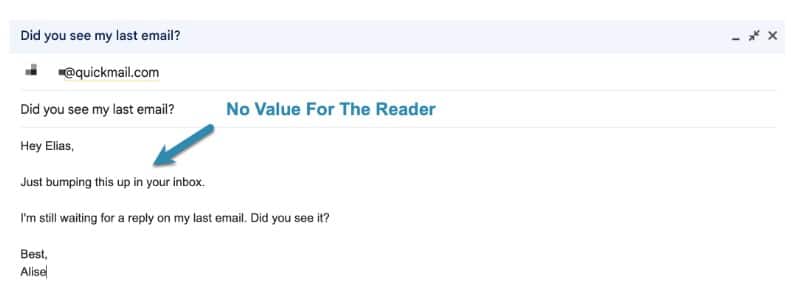
Don’t just write: “Did you see my previous email?” for every single follow-up. That’s just lazy emailing.
For example, you could include a link to a website, a podcast, or even a stat that shows you really mean what you’re talking about.
Always remember to share something of value in your follow-up emails that you would like your prospect to know about.
Don’t send your email before proofreading it.
There’s nothing worse than sending a professional email, and there are spelling mistakes or parts of the email missing.
Have a look at the email below…
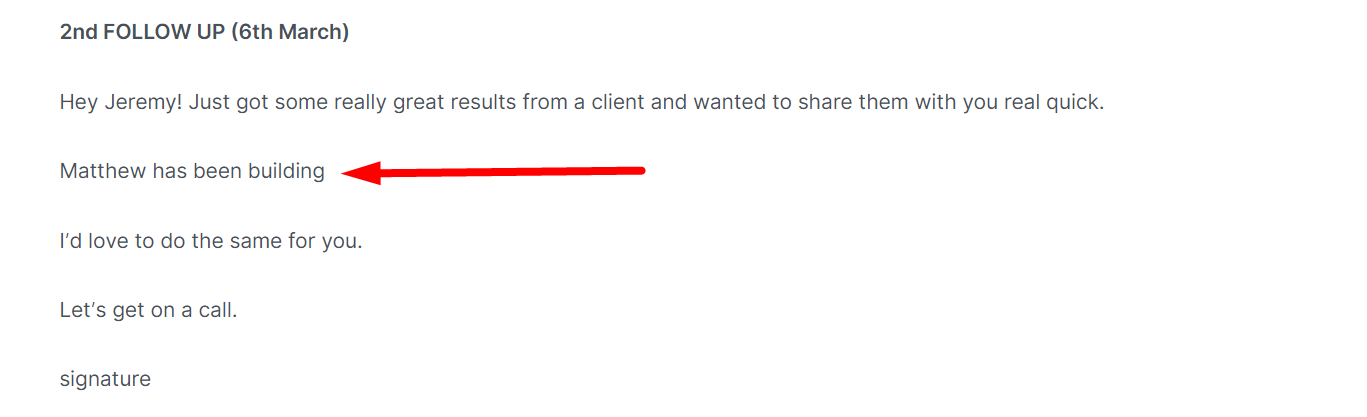
“Matthew has been building…” What?
So before you send your emails off, always check your piece of content. Make sure your spelling is correct and that you have completed your train of thought in the message.
If you don’t take the time to proofread your email sample, you’re going to come across as unprofessional.
Don’t have a weak CTA.
It’s essential to have a clear CTA so that the prospect knows exactly what you want them to do. A good option would be to just ask for a quick 15-minute call next week.
You could even add a calendar link or ask them for their calendar link so that you could schedule a call at a convenient time for them.
Remember your CTA should tell your prospects exactly what you want from them and move them to action.
Don’t bash your prospects.
Have a look at the example below:
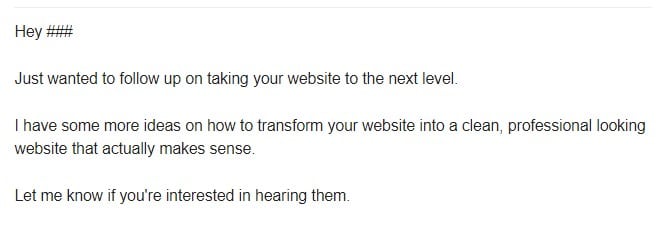
The sales professional mentions how they can turn the prospect’s website “into a clean website that actually makes sales.”
This implies:
- The prospect’s website is terrible.
- They are not making sales because their website does not look great.
This kind of email is enough to put any prospect off, as it can come across as offensive.
Once again, there is no clear value added to the email, and if the cold emailer wanted to help with web development, they could have come across more positively.
Remember, it’s easier to catch a fly with honey than with vinegar.
The same applies when trying to get someone interested in your product/service. Kindness and compliments can go a long way. Bashing a prospect is a surefire way to lose them.
Note: This is why personalization is so important. Adding something unique to the email that catches the prospect’s attention, like a compliment about their most recent achievement, is more likely to get a response than a bashing session.
Don’t write an “essay” for a follow-up email
Don’t send a really long email. Email isn’t the correct platform for long-form content.
A follow-up email should never be longer than a few sentences.
Why?
People don’t have time to read long emails.
If the salesperson wanted to add more context or content, they could have included a link to an article, for example, that discussed additional information.
But your best bet is to keep the message short and to the point.
Cold email follow up frequently asked questions
How can follow up email templates help in getting more positive reply rates?
Follow-up email templates can help inspire you to write something worthwhile.
Remember to always write a personalized intro. Templates can ensure your message is well-crafted, and this, in turn, can increase the likelihood of receiving a positive reply.
But without personalization and proper value, you won’t see many results.
How do I politely send a follow-up email?
A gentle email follow-up is like sending a friendly nudge to someone who hasn’t replied to your earlier message. Think of it like this:
You sent a message, maybe asking a question or pitching an idea, and the person didn’t respond. Instead of being pushy or impatient, a gentle follow-up just says, “Hey, forgot to add this link?”
It’s a simple way of bumping up your email without seeming too salesy or sending something that has no value. You’re not guilt-tripping the prospect or demanding a reply.
The Takeaway
If you follow the above tips and tricks, you will be able to 3x your response rates with potential customers.
You can take what you have learned from the above templates and incorporate the strategies into your own email campaigns.
Interested in learning more about effective email outreach in your sales process? Check out our cold email masterclass.
Or book a free 15-minute strategy session below.
