
B2B sales, or business-to-business sales, are simply companies selling products or services directly to other businesses rather than individual consumers.
The B2B industry is currently estimated at $6.7 trillion in the US alone. It’s also interesting to note that more than 50% of all B2B buyers are millennials.
This article will share what B2B sales is, along with the process, and how you can implement B2B sales at your company for more qualified sales leads.
(We will also share some examples of the B2B sales strategy we use to generate 20+ qualified sales leads per month for our clients. If you are interested in hiring an agency that specializes in b2b lead generation or have any questions, hop on a free 15-minute strategy session with us.
B2B Sales Definition
B2B sales just means business-to-business sales. It would include sales transactions between two businesses, rather than sales from business to consumer (B2C)
B2B sales often have:
-
Longer sales cycles
-
More educated buyers
-
Larger transaction amounts ( higher price range)
-
Multi-stakeholder approval (in some cases).
-
Relationship-building
-
Modern outbound sales strategies
How are B2B sales different from B2C?
B2B (business-to-business) sales is when a company sells to another company, and B2C (business-to-consumer) sales is when a company sells directly to individual consumers.
The biggest difference is usually:
-
Who you’re selling to
-
How long the buying process takes
-
How decisions are made
| B2B Sales | B2C Sales |
|---|---|
| Businesses sell to businesses | Businesses sell to consumers |
| Longer sales cycles | Faster buying decisions |
| Multiple decision-makers | Usually one buyer |
| Relationship-driven | Emotion-driven |
| Higher deal values | Lower average purchases |
| ROI-focused | Convenience or desire-focused |
| Customized solutions | Standardized products |
| Requires trust-building | Often impulse or emotional buying |
Example of B2B Sales
Some examples are a CRM software company selling to a sales team, or an SDR agency helping SaaS companies to book more meetings.
Another example is a manufacturer supplying parts to another manufacturer.
Example of B2C Sales
B2C, on the other hand, is someone buying shoes online, or a Netflix subscription… It could also be ordering food that’s delivered straight to your door.
How do B2B sales work?
B2B sales are more complex than B2C, but many of the same processes apply. For example, with B2B sales, you have to research your exact target audience.
Find out who really needs what you’re selling and which businesses have the budget for your product/service.
Ask yourself which pain points your company solves and think about how your sales team would use value propositions, pitches, and channels for your B2B selling process.
Your sales reps need to initiate the lead generation process, follow up, and complete the sale.
The B2B sales process
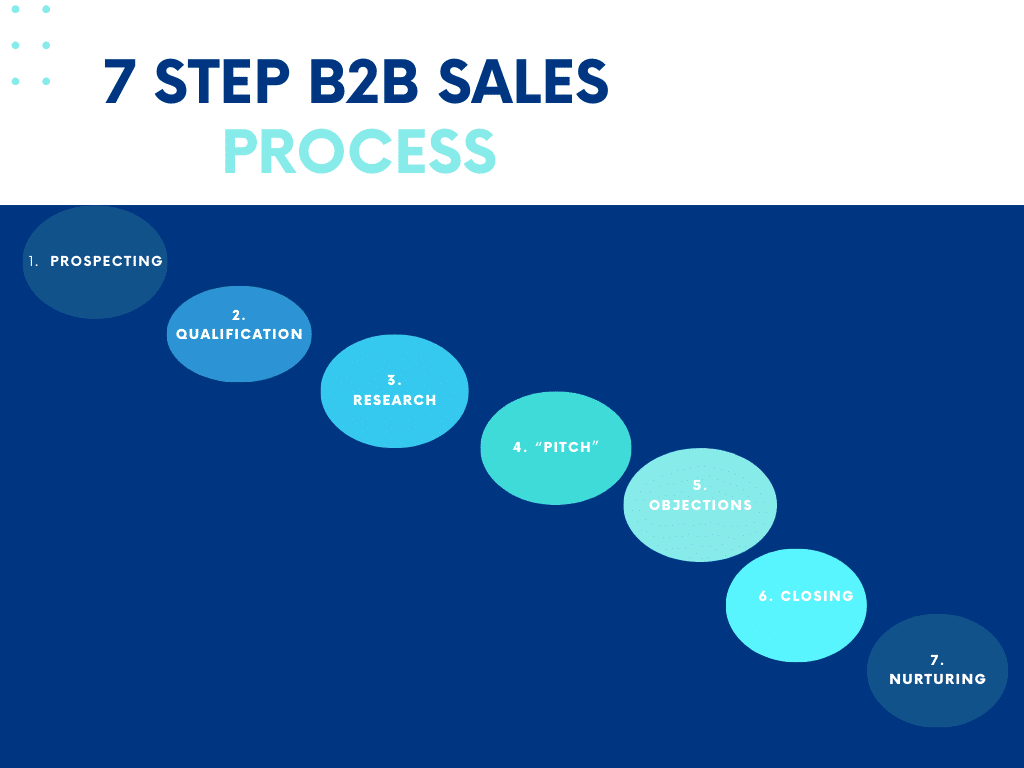
The B2B sales cycle is a 7-step process that sales teams should use. It’s a map that each member of the team should follow in order to move B2B customers down the sales funnel to help them make a purchasing decision.
This article shares how to find more b2b sales leads. )
This sales process includes:
- Prospecting
- Qualifying
- Research
- Your “sales pitch.”
- Handling objections
- Closing the deal
- Nurturing current clients to improve their customer experience, thus keeping them as paying clients.
I will discuss each step below in more detail…
Prospecting
Prospecting is when you find potential customers who might be interested in buying your product or service.
In B2B sales, prospecting usually means looking for companies that fit your ideal customer profile (ICP).
Sales teams look for businesses that will benefit from what they’re offering based on factors like industry, pain points, company size, and revenue.
Some prospecting methods
- Cold email outreach
- LinkedIn lead generation
- Cold calling
- Referrals
- Going to industry events
- Using lead databases and sales tools
Strong prospecting is important because it helps sales teams focus their time on high-quality leads instead of unqualified buyers.
Qualifying
Once a prospect shows interest, the next step is qualifying them.
Qualifying helps sales teams figure out if a lead is a good fit for their product or service. This stops businesses from wasting time on going after leads who won’t buy.
It’s really important to ensure that you go after leads who have the budget, the buying power, and the need, before you go after them.
Sales reps often qualify leads by asking questions such as:
- Does the company have a real need for the solution?
- Are they the decision-maker?
- Do they have the budget?
- Are they actively looking for a solution?
- How quickly do they want to implement it?
Many B2B companies use qualification frameworks like BANT (Budget, Authority, Need, Timing).
The goal is to focus on prospects who are most likely to become long-term customers.
Research (For personalized outreach)
Research is one of the most important parts of modern B2B sales.
Before reaching out or sharing your solution, sales reps typically research the company, industry, and decision-makers involved in the buying process.
This research may include:
- Understanding the company’s business model
- Seeing what the company’s pain points are
- Taking a look at recent company news
- Analyzing competitors
- Looking at the prospect’s LinkedIn profile
- Understanding current industry trends
Personalized outreach works way better than sending spammy generic sales messages. The more a sales rep understands a prospect’s business pain points, the easier it is to sell their solution. In fact, you shouldn’t even need to sell, but rather offer how you can help them.
Research also helps sales teams build trust and credibility during conversations because it shows that you have done your research.
Your Sales Pitch
The sales pitch is where the sales rep explains how their product or service can solve the prospect’s problem.
In B2B sales, a good sales pitch isn’t actually a sales pitch or about listing features. Instead, it focuses on the value and outcomes the buyer will get from buying the product or service.
A good B2B sales pitch typically:
-
Mentions the prospect’s specific pain points
-
Shows what ROI the prospect could get
-
Explains how the product or service can impact the business
-
Uses relevant examples or case studies
-
Shows how the solution compares to competitors
Modern B2B buyers expect personalized pitches tailored to their business goals and challenges.
Handling Objections
Most B2B buyers have questions or concerns before they buy.
Handling objections basically means handling those concerns and helping prospects feel like they are making a good buying decision.
Common objections in B2B sales could be about:
-
Budget concerns
-
Perhaps they already have a service provider
-
Timing issues
-
Concerns about ROI
-
Integration problems
Really good sales reps don’t view objections as rejection. Instead, they see them as opportunities to understand the buyer’s concerns.
The best way to handle objections is through:
-
Listening to the prospect
-
Showing empathy
-
Being a good communicator
-
Sharing data and case studies to build trust
-
And sharing value
Trust plays a huge role here. Why? Because B2B sales are normally quite pricey.
Closing the Deal
Closing is the stage where the prospect agrees to buy your product or service. In B2B sales, closing the deal may include:
contract negotiations, pricing discussions, legal approvals, and stakeholder approval. Because many people are involved in B2B buying decisions, this stage can sometimes take weeks or months.
Nurturing Current Clients
B2B sales don’t end after the contract is signed. One of the most important parts of long-term B2B business relationships and growth is nurturing your current clients in order to keep them.
What does this include?
-
You need to keep on communicating with your buyers
-
Good customer support
-
Regular check-ins
-
Upselling other products that you might have
-
Helping clients get better results
If you can keep your current clients to stay with you, it will be more cost-effective in the long run for your business, so nurturing clients is a really important step in B2B sales that you shouldn’t skip.
Here is the B2B sales strategy that we use at SalesBread
1. Build a list of your ideal target audience based on current buyers’ data
This article, 34 Filters To Find Your Target Accounts, shares different filters you can use to build a list of your ideal prospects.
PRO TIP: Use third-party data providers to help you build a prospecting list.
Such as Bombora, Data Miner, and Apollo. These lead generation tools can be super helpful for building prospecting lists.
SIDE NOTE:
Once you have built a look-a-like list, you can then plug it into LinkedIn Sales Navigator and refine it even further.
You do this by filtering your list through your second-degree network and those who recently posted.
This ensures that you are reaching out to individuals who are active on the platform, and studies have shown that people are more likely to accept your connection request if they are in your second-degree network.
Reach out to your list using personalized outreach messages on LinkedIn
Next, we send ultra-personalized connection requests to our prospects. These messages are based on research and aren’t a generic copy-paste sales pitch.
For example, we will use our CCQ method and write a personalized message for the prospect. This type of personalization goes beyond just typing an individual’s first name, though.
CCQ stands for:
-
Compliment
-
Commonalities
-
Questions
We will actually research each prospect on our list, and we do this by taking a look at their LinkedIn page, social media accounts, or Google their name.
We will then find something specific to compliment them on, mention a shared commonality, or ask them a question.
Here’s an example:
“Joe, I really enjoyed your webinar on how AI is changing the content marketing landscape. Especially the part about {{specific point}}… Would love to connect with you here.”
Follow up and ask for a booked call
Next, our b2b sales team will follow up with the prospects consistently (at least 6 touchpoints) until we get a reply. If they don’t reply via LinkedIn, our B2B sales reps will send them an email or an InMail. (If you enjoy cold calling, you could even reach out to them in that way.)
Use a clear CTA
We will also ask them for a quick call in our CTA.
Here are some examples:
-
Mind if we hop on a quick 10-minute call?
-
Would you be interested in learning more?
-
Are you available next week for a quick chat?
-
Send over your calendar link, and I will book a time that works for you.
Does this B2B sales technique work?
Yes, it does. Since 2019, SalesBread clients have averaged a 19.98% reply rate with our ultra-personalized LinkedIn Lead Generation Services.
And…
48.14% of those replies were either meeting requests or qualified sales inquiries on their product or service.
This method guarantees 1 qualified sales lead a day for our clients.
Here are some case studies if you’re interested in learning more about our strategy.
Modern B2B Sales Strategies to try
B2B buyers are more informed than ever before. There is so much information out there, and with AI, it’s really easy to research many companies in no time at all.
Most decision-makers have already researched your company, compared competitors, and looked at reviews.
Because of this, modern B2B sales is about building trust, personalization, and solving pain points.
Below are some of the best B2B sales strategies companies are using today.
Personalized Outreach

If you’re sending spammy AI-written outreach messages through LinkedIn, email, or even SMS, you stand the risk of getting ignored. People know when a message has been sent to 1000 other people.
Busy founders, CEOs, and CFOs get dozens of cold emails and LinkedIn messages every week, so personalization is what helps your message stand out from every other salesperson.
But the trick is to do more than just add the person’s first name. Rather, you want to do your research and find something specific to mention about the person in your messaging.
You can take a look at their LinkedIn profile and see if they were interviewed recently, or if they were featured on a podcast, maybe they have a strong opinion about something controversial, or they enjoy hiking… Mention something that shows you have done your research.
A good personalized message also mentions pain points. You should tailor your message to the buyer’s role as well.
The more relevant your outreach feels, the more likely prospects are to respond.
At SalesBread, we use our CCQ method:
-
Compliment
-
Commonalities
-
Questions
This helps our outreach feel more human and conversational instead of overly sales-focused.
Multi-Channel Prospecting
Next, you don’t want to use only one channel. A multi-channel approach will help you reach buyers on different platforms.
For example, at SalesBread, we like to use LinkedIn outreach, but then we like to move the conversation over to email.
You could use a mix of different methods, such as:
-
LinkedIn outreach
-
Cold email
-
Phone calls
-
InMail
-
Retargeting ads
Use Social Proof & Case Studies
Trust plays a huge role in B2B sales. Before making a buying decision, prospects often want proof that your product or service has worked for similar companies.
This is why it’s so important to use social proof.
You could either do this by sharing client testimonials, case studies, reviews, your successful metrics, and even LinkedIn posts where you share your knowledge. When people see you as the expert in your field, they will be more likely to reach out to you.
Value-Based Selling
In 2026, B2B buyers care less about features and more about what the outcomes will be. How will your product or service improve their lives?
Instead of focusing only on what your product does, focus on:
-
ROI
-
How it improves their lives
-
Revenue growth
-
How your tool or product saves time
-
How can it solve bleeding neck problems
The best B2B sales reps don’t just sell; they will show you how their solution is more than just another product or service, but how valuable it can be.
This is especially important in competitive industries where buyers are comparing many different companies, services, or tools.
The future of B2B sales
In the past, many companies just used cold calling, or cold email to reach out to prospective buyers; Maybe they even used traditional advertising methods, but there are so many new strategies to try to increase your results.
Here are some ideas:

Some of the best marketing strategies combine a mixture of outbound and inbound methods.
For example, your company might hire a sales rep and a content marketer.
For example, at SalesBread, we have a group of experienced B2B salespeople. Some have been trained to write ultra-personalized LinkedIn messages and build customer relationships.
Other aspects of our marketing include content marketing, SEO, email, and social media marketing.
Because of our multichannel approach, we can find a variety of prospects, and this, in turn, helps us to close deals regularly.
B2B Sales FAQs
What are some common challenges businesses face in B2B sales?
B2B sales is hard. Here are some of the biggest challenges:
Long sales cycles
Unlike B2C, where someone can buy in minutes, B2B deals can drag on for weeks or months. There are many stakeholders involved, budget approvals to get through, and procurement processes to navigate.
You need to be patient, but also persistent enough to stay top of mind without being annoying.
Getting in front of the right people
You can have the best pitch in the world, but if you’re talking to someone who can’t sign off on anything, it doesn’t matter.
This is why list building is so critical. Before you reach out to anyone, you need to know: are they a decision-maker? Do they have buying power? And do they actually need what you’re selling?
Standing out
Your prospects are getting hammered with outreach every single day. A good product isn’t enough on its own; you need a clear value proposition and social proof to back it up.
Why should they pick you over everyone else? Answer that question before you write a single message.
What trends should B2B sales teams pay attention to?
Use AI to research, not to write
AI tools like ChatGPT are genuinely useful for speeding up list building and research. What they’re not good at? Writing your outreach messages.
AI-written copy sounds like AI-written copy, and your prospects will notice. Use it to work smarter, not to cut corners on personalization.
Hybrid selling is here to stay
Some buyers still want to meet in person. Others are perfectly happy hopping on a Zoom call and making a decision the same week.
The key is flexibility; pay attention to what your audience actually responds to, and adapt accordingly.
Looking for B2B lead generation advice? Let’s talk
Whether you’re looking to hire a B2B lead generation agency or need help with your b2b strategy for more qualified sales leads, let’s talk.
Hop on a free 15-minute strategy session below.
